


The biological complexity of cassava—including its heterozygous nature, lengthy cropping cycles, asynchronous flowering, and poor seed sets—drives a lengthy product development process (Ceballos et al., 2004; Ceballos et al., 2012). Incorporating genomic information into breeding programs and using efficient, cost‑effective genotyping improves breeding decisions, shortens the breeding cycle, increases selection intensity, maximizes genetic gain, and accelerates the development of breakthrough products that can replace widely grown varieties.
Amplicon sequencing based on custom panels is increasingly popular due to its experimental flexibility, capacity to process many loci and samples, and cost‑effectiveness. The cassava custom sequencing‑based amplicon panel 3K‑CassCA was developed collaboratively by the International Institute of Tropical Agriculture, the Alliance of Bioversity International and CIAT, Cornell University, EMBRAPA, and the Excellence in Breeding Initiative.
Panel Overview
The panel comprises 3,002 SNP markers: 2,984 SNPs across 18 chromosomes and 18 SNPs on unplaced scaffolds.
- Trait‑linked SNPs: 15
- Quality control markers: 1991
- Diagnostic markers for Manihot glaziovii introgressions (chr1 & chr4): 45
- SNPs within genic regions: 563
- Other genome‑wide markers: 2,180
Applications
- Trait profiling and marker‑assisted selection
- Characterization of breeding materials and relationship assessment
- Identification of true‑to‑type samples and duplicates
- Genomic prediction (selecting optimal crosses and accelerating selection)
- Facilitated cross‑study and cross‑program comparison by querying the same loci
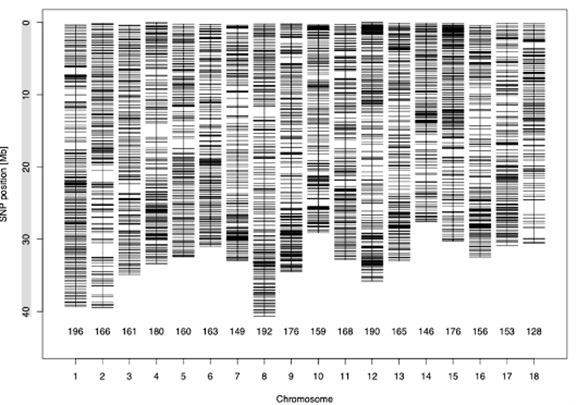
SNP marker distribution in the 3K‑CassCA
References
- Ceballos, H., C.A. Iglesias, J.C. Perez, and A.G.O. Dixon. 2004. Cassava breeding: opportunities and challenges. Plant Mol Biol 56: 503–516.
- Ceballos, H., P. Kulakow, and C. Hershey. 2012. Cassava Breeding: Current Status, Bottlenecks and the Potential of Biotechnology Tools. Trop Plant Biol 5: 73–87.
- 1 Excellence in Breeding (EiB) Module 3 – KASP resources: excellenceinbreeding.org/module3/kasp